Guided Entry System

Overview
This case study walks through a full product cycle on smallcase: a UX teardown of existing flows, reverse-engineering what makes its core features work, user segmentation, interviews and survey validation, a SWOT analysis, and finally a prioritized, wireframed solution aimed at one problem.
About smallcase
smallcase exists to introduce a new generation of investors to the Indian equity markets using technology. It monetizes through transaction fees on investments and SIPs, premium subscription plans, and commissions via broker partnerships for trades executed through its platform.
For users, smallcase simplifies investing by reducing cognitive effort and making portfolio decisions easier and more guided. For the business, this translates into higher transaction frequency and subscription adoption, driving retention and revenue.
| Competitor | Their Approach | Smallcase's edge |
|---|---|---|
| WealthDesk | Curated WealthBaskets of stocks and ETFs from SEBI-registered advisors via broker apps. | A broader marketplace of thematic portfolios and a unified investing experience. |
| Cube Wealth | Personalized portfolios and one-on-one advisory for busy professionals. | Ready-made thematic portfolios for self-directed investors, without direct advisor involvement. |
| 5Paisa (Cirrus) | Model portfolios and advisory tools within a full-featured trading platform. | Purely focused on thematic investing across brokers, avoiding broader trading features. |
Product Teardown: Flows & Frictions
Before identifying a problem to solve, I mapped three core money-movement flows in the existing product end-to-end - what works, and where users hit friction.
Invest More
Flow: Existing smallcase → Invest more → Make Payment → Order placed.
The transaction flow is smooth when sufficient funds already exist on the broker platform (e.g. Zerodha Kite).
Each order requires a minimum balance, but if funds are insufficient on Kite, the user is only notified at the final payment step. After entering an investment amount and clicking "Invest more," the flow redirects to the Kite payment page with no minimum-amount constraint or prefilled value - letting users enter less than required and breaking the flow again.
Add Funds
Flow: Profile → Account management → See available funds → Add Funds (CTA) → Redirect to broker.
Users can view available funds within smallcase and access the broker's add-funds page via a CTA.
Users can't add funds directly from smallcase. Clicking "Add Funds" redirects to the broker's web interface even if the broker app is installed, breaking app continuity.
Rebalance
Flow: smallcase → Rebalance → Redirected → Modify or approve → Order placed.
A clear breakdown of buy and sell actions, with flexibility to customize before rebalancing.
Users are redirected to an external link to complete the rebalance, disrupting the in-app experience.
Feature Reverse Engineering
I reverse-engineered three existing smallcase features to understand the user problem each was designed to solve, and why it works for both sides of the marketplace.
Expert-Curated Portfolios
Ready-made smallcases built by experts around themes, goals, or sectors instead of analyzing individual stocks.
One-Tap Rebalancing
Notifies users when it's time to rebalance, then executes all buy/sell actions via the broker in one tap.
Investment Score & Portfolio Breakdown
Breaks holdings into stable, steady, and high-growth categories to guide rebalancing decisions.
Each feature solves a specific anxiety: not knowing where to invest, not wanting to track markets, and not understanding portfolio risk. For users, this means less research and more confidence. For smallcase, it drives engagement, subscriptions, and repeat investments.
User Segmentation
I segmented smallcase's user base into six groups to identify where the sharpest, most addressable problem lived.
| Segment | Need | Hypothesized Problem |
|---|---|---|
| Passive Investors (Long-term Holders, SIP Investors) | A quick way to track all ongoing SIPs in one place. | SIP status is scattered across individual smallcases, so users must open each one to confirm whether an SIP is active. |
| Active Investors (Portfolio Optimizers, Market Movers) | Portfolio suggestions that adapt to their changing risk appetite. | Current suggestions use a fixed composition of stable, steady, and high-growth smallcases, making recommendations irrelevant to individual risk profiles. |
| Occasional Investors (Bonus-time, Event-driven) | A smooth one-time investment flow without last-minute blockers. | Users often realize at the final order step that they don't have enough broker funds, forcing them to add money separately and restart the process. |
| Learners / First-timers (New Explorers, Trial Investors) | Guidance to start investing without feeling overwhelmed by too many choices. | The large number of smallcases (including free ones) makes it difficult for beginners to confidently pick their first or second investment. |
| Delegated Investors (Expert Followers, Advisor-led) | - | - |
| Institutional / Partner Users (Wealth Advisors, Platform Partners) | - | - |
Initial Problem Hypotheses
From the teardown and segmentation, I drafted three early problem hypotheses, prioritized by gut confidence ahead of user validation.
Event-driven Investors struggle to complete time-sensitive orders when they discover insufficient broker funds at the final step, because there's no early prompt to check or add funds - leading to frustration, delays, and missed opportunities.
New Explorers struggle with choosing their first investment when faced with a wide range of smallcases, because there's limited guided discovery or filtering based on user goals - leading to decision fatigue and drop-off before investing.
Portfolio Optimizers struggle to align their portfolios with their risk appetite when making changes, because the platform suggests adjustments based on a generic benchmark rather than their current profile - leading to irrelevant advice.
User Research
Interviews
I interviewed 3 early-career professionals (~20–25 minutes each), spanning SIP investors, a stock investor, and a crypto-first investor, to validate the P2 hypothesis.
Key Behaviour Patterns
Started investing after first salary.
Prefer low-effort, long-term investing (SIPs, set and forget).
Track portfolios lightly, mostly just total value/profit.
Decision-Making Patterns
Low confidence choosing independently.
Strong reliance on family/friends for guidance and activity slows or stops if guidance disappears.
Unexpected Insights
One stopped investing after losing access to guidance, another delayed starting for over a year.
Delegation to trusted people is a behaviour, not just a preference.
Pain signals from real experiences:
- "I rely on my brother for most investment decisions."
- "I want to invest and forget about it."
- "I don't know where to start with SIPs."
- "There's too much information online."
Survey Validation
To check whether these patterns held beyond 3 interviews, I ran a short survey with 13 responses, mostly SIP users, after the interviews.
Together, this confirmed the interview patterns: investors prefer low-effort approaches, decision confidence is moderate to low, and confusion plus choice overload slow down action. Guidance and simplicity are strongly desired.
SWOT Analysis
Built from the interviews, survey, product teardown, and comparative observation of platforms like mutual fund apps, broker platforms, and SIP-first solutions. Since most participants weren't existing smallcase users, this reflects external user behaviour and market positioning rather than internal usage data.
STRENGTHS
Strong fit with guidance-seeking behaviour (75% follow friend/family suggestions). Positioned between DIY stocks and SIPs - more control than SIPs, less effort than stock picking. Aligns with the low-effort investing mindset (84% just check profit/value).
WEAKNESSES
Low awareness among passive investors - a discovery gap in the SIP-first audience. Heavy dependence on human advice; users trust people more than platforms. Confidence gap creates hesitation - only 7.7% feel very confident.
OPPORTUNITIES
Huge demand for guidance (75% want simple guidance). Confusion-driven delay is widespread - the biggest barrier is decision overload, not lack of interest. Passive investors want simplicity, signaling the market is primed for low-effort experiences.
THREATS
SIPs dominate passive investor comfort, representing strong habit and trust in mutual funds. Inaction is a major competitor - people pause instead of switching platforms. Trust lies with known people, meaning human networks compete directly with platforms.
Problem Statement & Goal
New and passive investors struggle to confidently choose where to invest due to too many options and lack of clear guidance, leading to delayed or avoided investment decisions.
Resulting behaviour: users delay starting investments, depend on trusted people for decisions, and avoid trying new platforms without clear direction. Interviews showed users paused investing entirely when guidance was unavailable.
This hesitation directly reduces Activation as users discover investment options but don't take the first investment action due to decision uncertainty.
Improve activation rate by ~15% in the next 6 months for new/passive investors by reducing decision confusion at the investment selection stage.
Personas
Priya Gupta - Passive SIP Investor (family-managed)
Mid-20s, UX Designer. Decision style: trust-based, but curious to learn.
Goals: Grow money safely over the long term, avoid wrong decisions, learn investing gradually without spending too much time.
Behaviours: SIP investments managed by an uncle/family member; rarely decides independently; checks portfolio occasionally (mainly total value/profit); shows interest in learning but doesn't actively research.
Frustrations: Too many investment options feel overwhelming; research feels time-consuming and confusing; low confidence choosing investments independently.
"I just want to invest and forget, but I also want to understand what's happening."
Deep Patel - Early-Stage Investor (started but paused)
Early-20s, UX Designer and Developer. Decision style: relies on trusted family guidance.
Goals: Invest early and grow money over time, in a way that feels safe and guided, without needing constant involvement.
Behaviours: Started investing after his first salary; followed his brother's guidance for stock selection; stopped investing once that guidance became less available; watches YouTube content but rarely acts on it independently.
Frustrations: Fear of losing money on wrong decisions; feels investing requires constant research and market tracking; unsure if current investments will grow meaningfully; feels stuck between continuing, switching, or withdrawing.
"I stopped investing because I didn't feel confident making decisions on my own once my brother got busy."
Problem Prioritization
Considered problems from interviews, survey, and the SWOT: confusion about where to invest, low confidence in decisions, dependency on trusted people for guidance, and research feeling heavy and time-consuming. All four contribute to hesitation in starting investments.
New and passive investors struggle to confidently choose where to invest due to too many options and lack of clear guidance, leading to delayed or avoided investment decisions.
Solution Brainstorming
Ten candidate solutions were generated against the P0 statement and categorized by build effort.
| Solution | Description | Key Assumption |
|---|---|---|
| Smallcase-Specific Referrals | Allow existing investors to refer a specific smallcase (not the platform generically) to friends/family. | Users trust choices recommended by people they know. |
| Contextual Personalized Suggestions | Collect user inputs (goals, risk appetite, capacity) and recommend best-fit smallcases with a guided roadmap. | Personalized guidance reduces confusion and speeds decisions. |
| Ratings & Reviews for Smallcases | Let existing investors rate and review a smallcase. | Validation builds confidence and cuts hesitation. |
| Reduce Visible Choices (Curated Top Picks) | Show only a limited Top 3–5 smallcases for new users to prevent overwhelm. | Fewer options limit decision fatigue and spur action. |
| Explain "Why This is Recommended" | Show simple reasoning per recommendation (e.g. fits long-term goal + medium risk + low involvement). | Transparency increases trust and confidence. |
| Re-activation Incentives | Nudge paused users with small incentives (e.g. ₹100 off on next ₹5k investment). | Small financial nudges trigger action among hesitant users. |
| Similar-Profile Social Proof | Show "People like you invested in these smallcases" based on age, risk profile, etc. | Users trust decisions made by similar peers. |
| Smart Onboarding Quiz (Top 3 Fit) | Quick onboarding quiz mapping users to best-fit smallcases. | Guided entry with limited options reduces confusion. |
| "Most Invested This Month" Section | Highlight trending smallcases based on recent investment activity. | Users rely on crowd behavior as a decision shortcut. |
| "Top Beginner Picks" Section | Dedicated entry point featuring beginner-friendly smallcases that historically worked well. | New investors prefer starting with proven, low-risk options. |
RICE Prioritization
| Solution | RICE Breakdown |
|---|---|
| Smallcase-Specific Referrals | Reach 2 · Impact 3 · Confidence 2 · Effort 2 Score: 6 |
| Guided Entry System (Quiz + Suggestions + Why Recommended) | Reach 3 · Impact 3 · Confidence 3 · Effort 3 Score: 9 |
The Guided Entry System scored highest on RICE and became the P0 solution.
P0 Solution: The Guided Entry System
The Guided Entry System introduces a structured onboarding flow that collects user goals, risk appetite, investment capacity, and involvement preference. Based on this, users receive a curated roadmap of best-fit smallcases along with contextual explanations.
This directly reduces:
- Choice overload
- Decision anxiety
- Reliance on external guidance
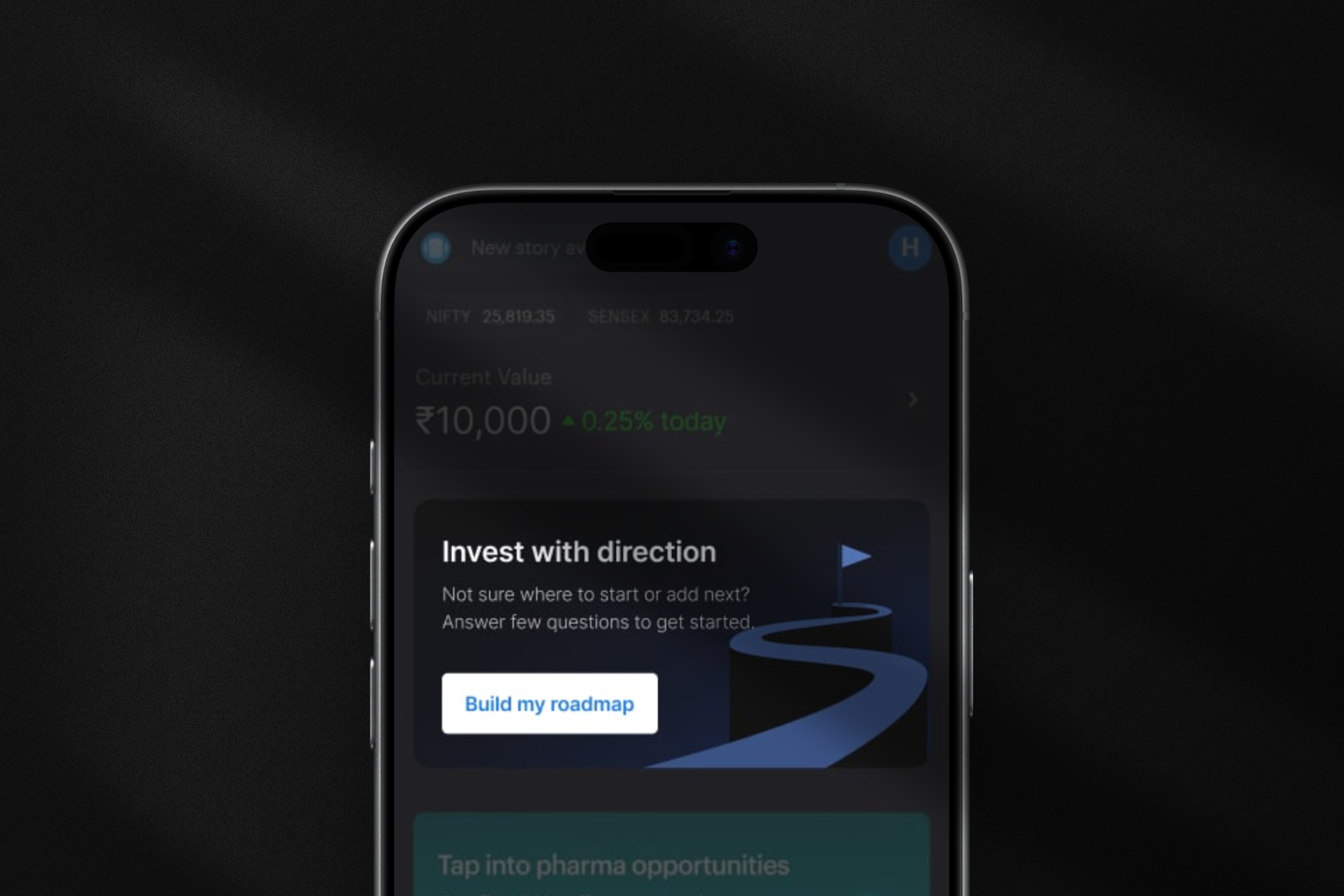
Entry Trigger
Location: shown on first sign-in, or as a Home banner - "Invest with direction." CTA: "Build my roadmap."
This ensures new users get guidance immediately, while existing passive users can re-enter decision support at any time.
Flow Summary (5 Steps)
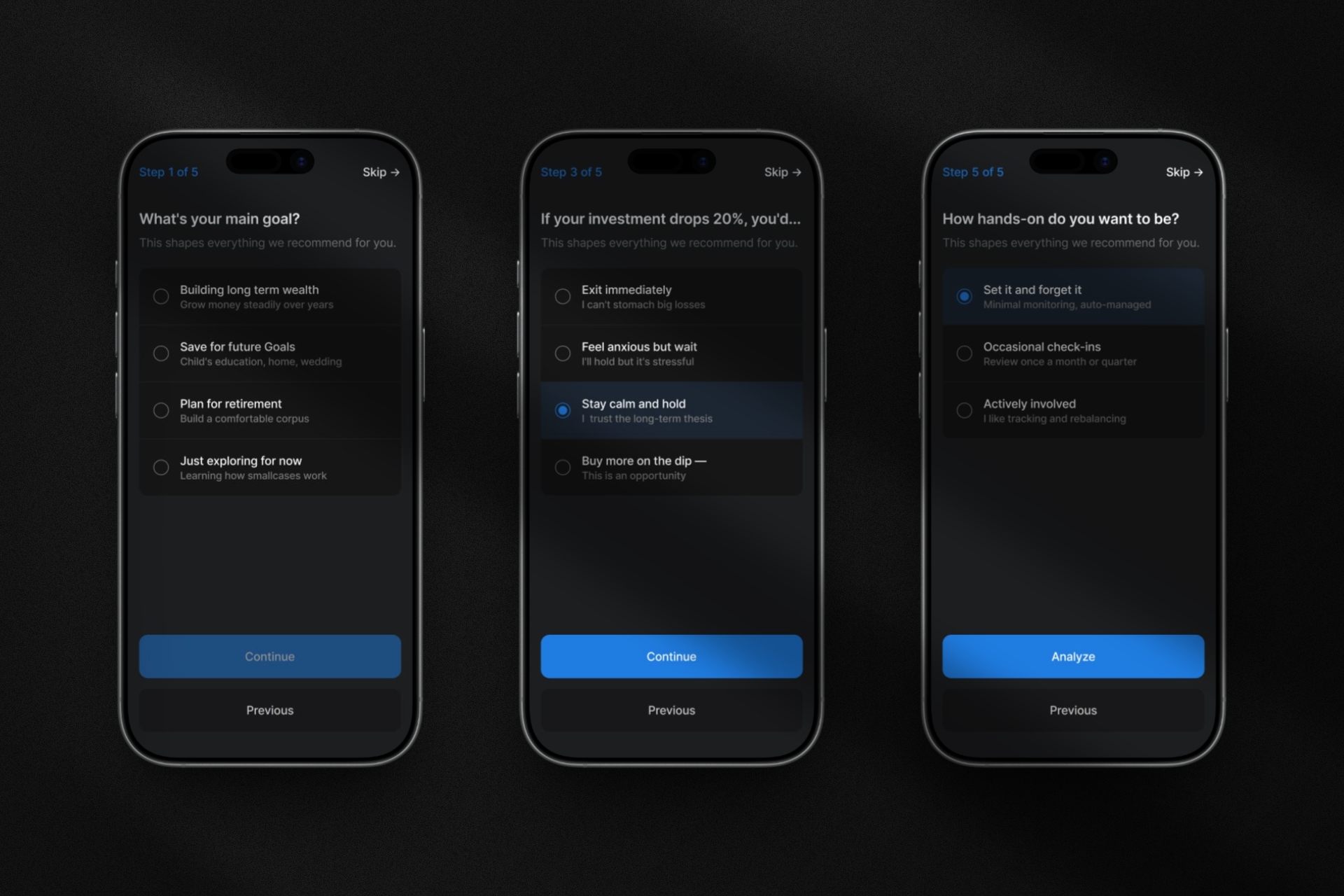
A short onboarding flow captures the user's investment goal, time horizon, risk appetite, investment capacity, and involvement preference to build an investor profile.
- Goal selection: e.g. building long-term wealth, saving for a future goal, planning for retirement, or just exploring.
- Time horizon: within 1 year, 1–3 years, 3–7 years, or 7+ years.
- Risk tolerance: framed behaviorally around a 20% portfolio drop scenario (exit immediately, feel anxious but wait, stay calm and hold, or buy more on the dip).
- Monthly capacity: under ₹2,000, ₹2,000–₹5,000, ₹5,000–₹15,000, or ₹15,000+.
- Involvement preference: set it and forget it, occasional check-ins, or actively involved.
Recommendation Layer
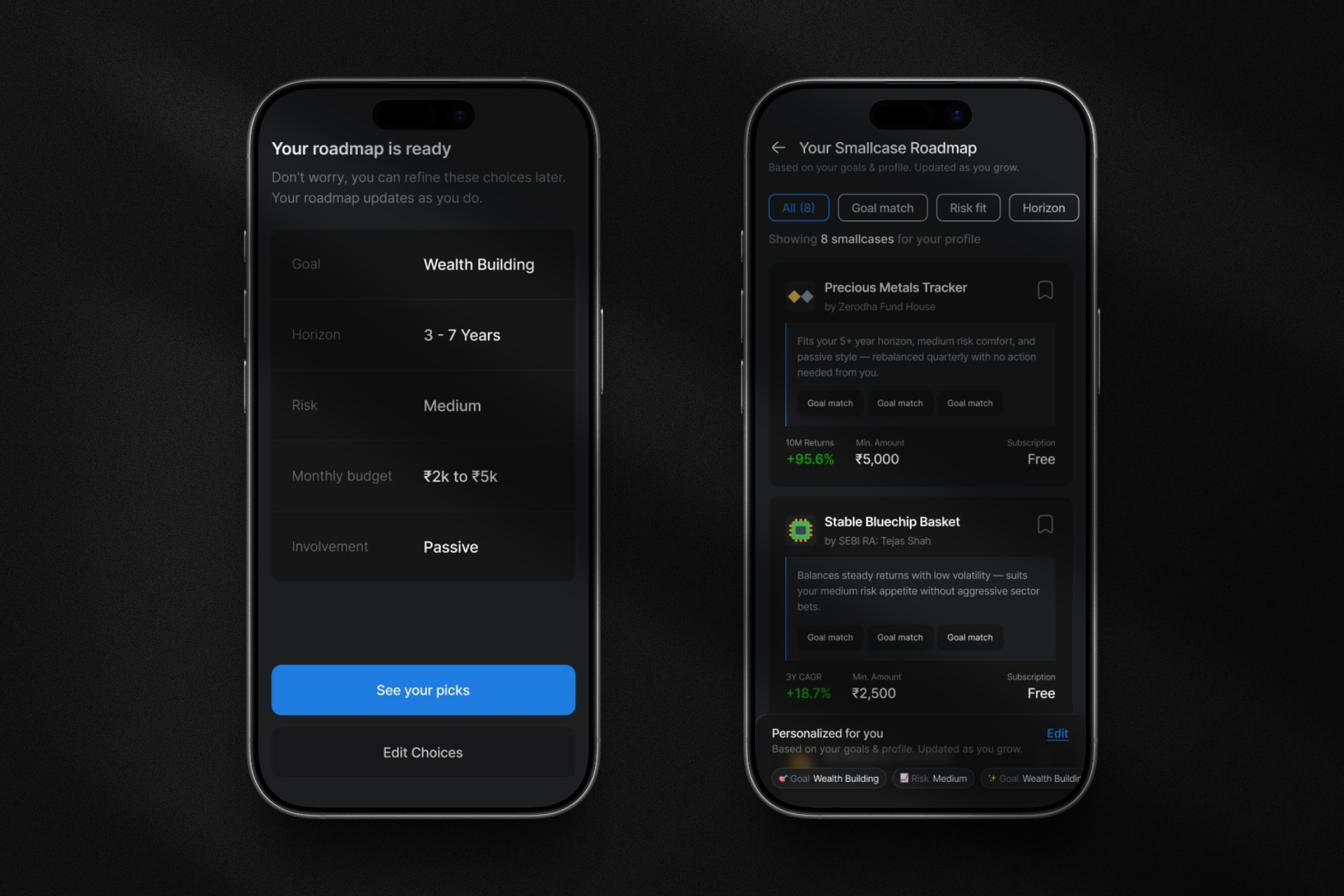
Each recommended smallcase surfaces:
- A fit explanation across goal match, risk match, and horizon match
- A simplified summary
- Minimum investment required
- A performance snapshot
Based on user inputs, the system generates a curated shortlist of relevant smallcases along with contextual explanations that help users understand why each recommendation is a good fit.
How This Solves the P0
Problem: users delay investing due to confusion and too many options.
This solution narrows choices down to 3–8 contextual picks, explains the reasoning behind each, and makes the decision feel structured rather than overwhelming.
Expected behavioral shift: from browsing endlessly, to selecting from a guided shortlist.
Success Metrics
| Type | Metric | Why It Matters |
|---|---|---|
| Key Metric | First Investment Conversion Rate (New/Passive) | Direct measure of activation improvement. |
| Secondary | Quiz Completion Rate | Measures willingness to engage with structured guidance. |
| Secondary | Recommendation Click-through Rate | Indicates relevance of suggestions. |
| Secondary | Investment Rate from Recommendations | Validates personalization effectiveness. |
| Guardrail | 30-Day Retention | Ensures long-term quality, not forced activation. |
| Guardrail | Quiz Drop-off Rate | Protects against friction overload. |
Pitfalls & Mitigations
Key assumptions behind the Guided Entry System, mapped against their failure modes and mitigation plans.
| Assumption at Risk | Failure Mode | Mitigation |
|---|---|---|
| Users engage with the quiz | Users skip it (High impact / Medium likelihood) | Short flow, clear value prop, contextual entry point. |
| Users trust the recommendations | Users don't invest after the quiz (High impact / High likelihood) | Explain "why recommended," show fit score. |
| Logic gives relevant picks | Users feel misaligned post-investment (High impact / Medium likelihood) | Clear risk explanation, editable profile. |
| Users answer honestly | Random answers → poor fit (Medium impact / Medium likelihood) | Behavioral questions, supportive microcopy. |
Detection signals tracked per risk: quiz start and completion rate, investment rate from recommendations, 30-day churn, and completion-time anomalies.